Cinephile No. 1,373 “The Testament of Dr. Mabuse”
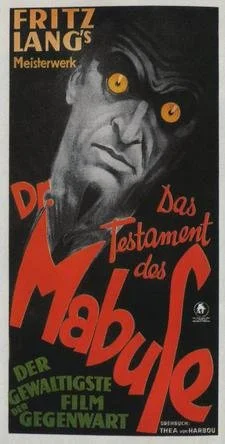
Recommendation: 2/5 Stars
Plot: “A criminal mastermind uses hypnosis to rule the rackets after death.”
Review: This is a review of the 1933 film, “The Testament of Dr. Mabuse.” At the same time, this is not a review of the 1933 film, “The Testament of Dr. Mabuse.” I will explain.
This film is the 1.373rd film I have watched in a theater. It joins a choir of thousands and thousands of films I have watched in the comfort of my home or someone else’s. It also joins a special group of several hundred films I have chosen to review, with the purpose of sharing my thoughts with the world.
When I review a film, whether in the theater or at home, I carry a notebook with me. My goal for the notebook is to capture my reactions as the story progresses. I note my emotional reactions to the story, themes worth exploring more deeply, and choices that might catch my attention.
Back at the comfort of my desk, I assemble these notes into a review that is drafted and redrafted before it is shared with a wider audience. As I write the essay, these notes are carelessly deleted from the page once they are used in the review. When the final product is shared with the world, my notes live in no other place than my notebook.
In all those reviews, I have never shared my notes with anyone. That changes today. It more than likely will never happen again. I am choosing to do this today, because I want to show you the journey of my experience with this film – a film I desperately wanted to like.
My notes from “The Testament of Dr. Mabuse”
1. Sound design – transition
2. A detective tale and a villain
3. Feels scattered
4. How will it be pulled together?
5. Building a case
6. The art of confusing cinema
7. Struggling to find the plot
8. Explosion/car chase
9. An essay on confusing film
Of course, you have read my notes and decided there is not much there. You might ask yourself, “these are his notes?” “How on Earth does he pull this together to form a review?” Both questions are fair. Perhaps at some point in the future, I might share my process of taking these notes and turning them into a review. In fact, I am committed to this idea. That sounds like fun.
But for the purpose of this review, I want to drill deeper into note #9 – an essay on confusing film.
I think of myself as an intelligent guy. Others may disagree, but their opinions matter little to me. I see myself as a smart guy, and that is all that matters. I am also not one to shy away from challenging films. Films like “Memento,” which upon first viewing can feel confusing, excite me. But to get there, the payoff, born in a mountain of confusion, must be exceptional.
Unpacking a story is exciting. The sudden realization that comes from discovering what is happening can feel like an epiphany. It is a moment of pride. When I unpacked “Memento” for the first time, I felt overjoyed. I felt like I was in the know. I felt proud of myself. With everything solved, this film’s emotional weight was allowed to lay across me in a way that felt special.
What I cannot tolerate is arriving at the end of the movie with lingering confusion. I cannot return to my car as if everything is normal. I cannot tolerate the feeling that something has been lost on me. I immediately begin to doubt my own intelligence without first questioning the storytelling techniques used in a film. For my own emotional health, that is not a place I enjoy.
And then there are the comparisons I make to those who had their own “Memento” moments with a film I found confusing and challenging. This is when confusion turns to frustration. Frustration is not a movie-going emotion I tolerate.
I am not asking to be placed in a highchair and fed the plot of a movie. I want writers and filmmakers to make the best choices for their stories. I know that detective stories can be confusing by their very nature. As evidence is gathered, we are piecing a story together, in hopes of fully constructing exactly what transpired. We are the detective, and the detective is us.
In these stories, a certain level of confusion and frustration is expected. But the great detective stories, stories like “Knives Out,” do not allow these feelings to linger. They deliver satisfying conclusions, where these feelings are shifted into satisfaction. For all the confusion I found in the plot of “The Testament of Dr. Mabuse,” I did not find the result satisfying. I left the theater, opened Letterboxd, and began thinking, “What did I miss?”
Be good to each other,
Nathan
As a member of the factory, you are taking a stand for human powered creation.